


























0
Views
0
Downloads

Save
0 Likes
Share
Commonly Confused Words Chart
0 Views
0 Downloads
Paste this activity's link or code into your existing LMS (Google Classroom, Canvas, Teams, Schoology, Moodle, etc.).
Students can open and work on the activity right away, with no student login required.
You'll still be able to track student progress and results from your teacher account.
Information
Description
What It Is:
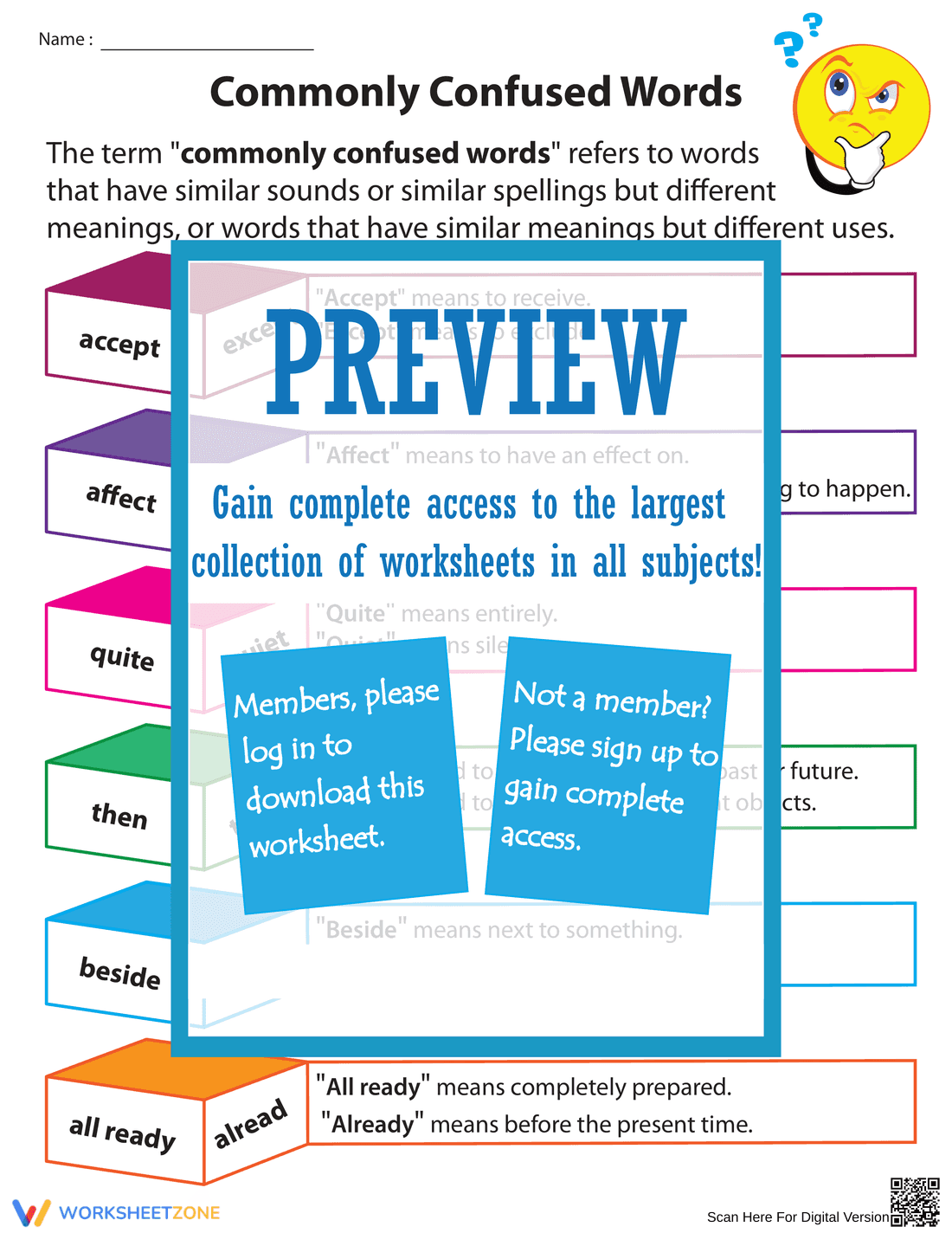
This is a worksheet focused on commonly confused words. It presents pairs of words like 'accept' and 'except,' 'affect' and 'effect,' 'quite' and 'quiet,' 'then' and 'than,' 'beside' and 'besides,' and 'all ready' and 'already.' Each pair is visually represented with colorful blocks and includes a definition for each word. There are blank lines next to each word pair, presumably for students to write sentences or examples.
Grade Level Suitability:
This worksheet is suitable for grades 3-5. The vocabulary and concepts are appropriate for this age range as students begin to encounter these commonly confused words in their reading and writing. The definitions provided are clear and concise, aiding comprehension.
Why Use It:
This worksheet helps students distinguish between words that sound or look similar but have different meanings. It reinforces vocabulary development, improves reading comprehension, and enhances writing skills by preventing common errors in word usage. It also provides a visual aid to help students remember the differences.
How to Use It:
Students can read the definitions of each word pair and then write their own sentences using each word correctly in the provided blank spaces. The worksheet can be used for individual practice, classroom activities, or as a review tool. It could also be used as a starting point for a class discussion about the nuances of language.
Target Users:
The target users are elementary and middle school students (grades 3-5) who are learning about commonly confused words. It is also useful for ESL students who are working on expanding their English vocabulary and understanding subtle differences in word meanings. Teachers and homeschool parents can use it as a supplemental learning resource.
This is a worksheet focused on commonly confused words. It presents pairs of words like 'accept' and 'except,' 'affect' and 'effect,' 'quite' and 'quiet,' 'then' and 'than,' 'beside' and 'besides,' and 'all ready' and 'already.' Each pair is visually represented with colorful blocks and includes a definition for each word. There are blank lines next to each word pair, presumably for students to write sentences or examples.
Grade Level Suitability:
This worksheet is suitable for grades 3-5. The vocabulary and concepts are appropriate for this age range as students begin to encounter these commonly confused words in their reading and writing. The definitions provided are clear and concise, aiding comprehension.
Why Use It:
This worksheet helps students distinguish between words that sound or look similar but have different meanings. It reinforces vocabulary development, improves reading comprehension, and enhances writing skills by preventing common errors in word usage. It also provides a visual aid to help students remember the differences.
How to Use It:
Students can read the definitions of each word pair and then write their own sentences using each word correctly in the provided blank spaces. The worksheet can be used for individual practice, classroom activities, or as a review tool. It could also be used as a starting point for a class discussion about the nuances of language.
Target Users:
The target users are elementary and middle school students (grades 3-5) who are learning about commonly confused words. It is also useful for ESL students who are working on expanding their English vocabulary and understanding subtle differences in word meanings. Teachers and homeschool parents can use it as a supplemental learning resource.


